Measuring Pipe Gradients on Site Without a Laser Level
Posted on: 15th May 2026

All above ground and below ground horizontal drainage pipes need to be laid to a sufficient gradient – this is usually somewhere from 1 in 40 to 1 in 100. This means it’s important to pay attention to measuring pipe gradients correctly.
So why is this necessary? In a nutshell, the gradient or fall is needed to allow the pipes to drain. A completely level drainage pipe, or one with a gradient of less than 1 in 100, could cause the flow to slow down and solid waste to become stranded, causing a blockage. A gradient between 1:40 to 1:100 is usually enough for adequate flow velocities.
So how do you calculate the fall of a drainage pipe?
Fall calculations are made when planning a building project in order to provide adequate flow rates and ensure solids don’t cause blockages in the drainage system. To put it simply, the “fall” of a pipe means the vertical amount the pipe drops from point A to point B over a certain distance. This means a gradient can be defined as fall divided by distance.
GRADIENT = FALL / DISTANCE
So for example, a 1 in 40 pipe fall means that for every 40 units of length, the pipe drops by 1 unit. So in a 40 metre run of pipe, the pipe would drop vertically by 1 metre. And the gradient would then be 1/40, or 0.025.

What’s the easiest way for measuring pipe gradients?
Often, on-site contractors tend to use laser levels to prove to the site inspector or Building Control that the pipe they’ve laid is within the correct parameters made during planning. Laser levels are expensive though, and for a home DIYer, self-builder or jobbing builder needing a quick check, this kind of specialist equipment isn’t always available.
There are also various DIY solutions with spirit levels like this one, but there is also another way which will save you time and effort on site.
Metex PipeFall is a unique manual pipe gradient measuring tool with pre-set falls of 1:40, 1:60, 1:80 and 1:100. It allows the installer to quickly and accurately lay drainage pipes to a required fall, or do a quick check to prove the gradient to the site inspector – without having to invest in a laser level or spend extra time and effort putting together a DIY solution.
It’s simple to use, as all you need to do is lay the tool over the pipe wiht the spirit level pointing downstream, turn it around to show the desired gradient on the top, and then adjust the pipe until the spirit level bubble shows when the fall has been achieved – see how in the video below!
Redesigning Pipefall
Pipefall’s old design was about 1.6m long with a sliding spirit level, but was slightly cumbersome and not ideal for shorter lengths of pipe, so we redesigned the tool for convenience. The current version is less than 1m long, which allows it to be handled, stored and transported conveniently and makes it easier to use with shorter pipes.
It’s made from the same tough materials as the previous version: An anodised aluminium section with an engineering plastic body which houses the spirit level. The engineering plastic used to house the spirit level is tough and impact resistant – in fact it’s the same material used to manufacture LEGO blocks! We all know how tough these are and how painful they are to tread on…
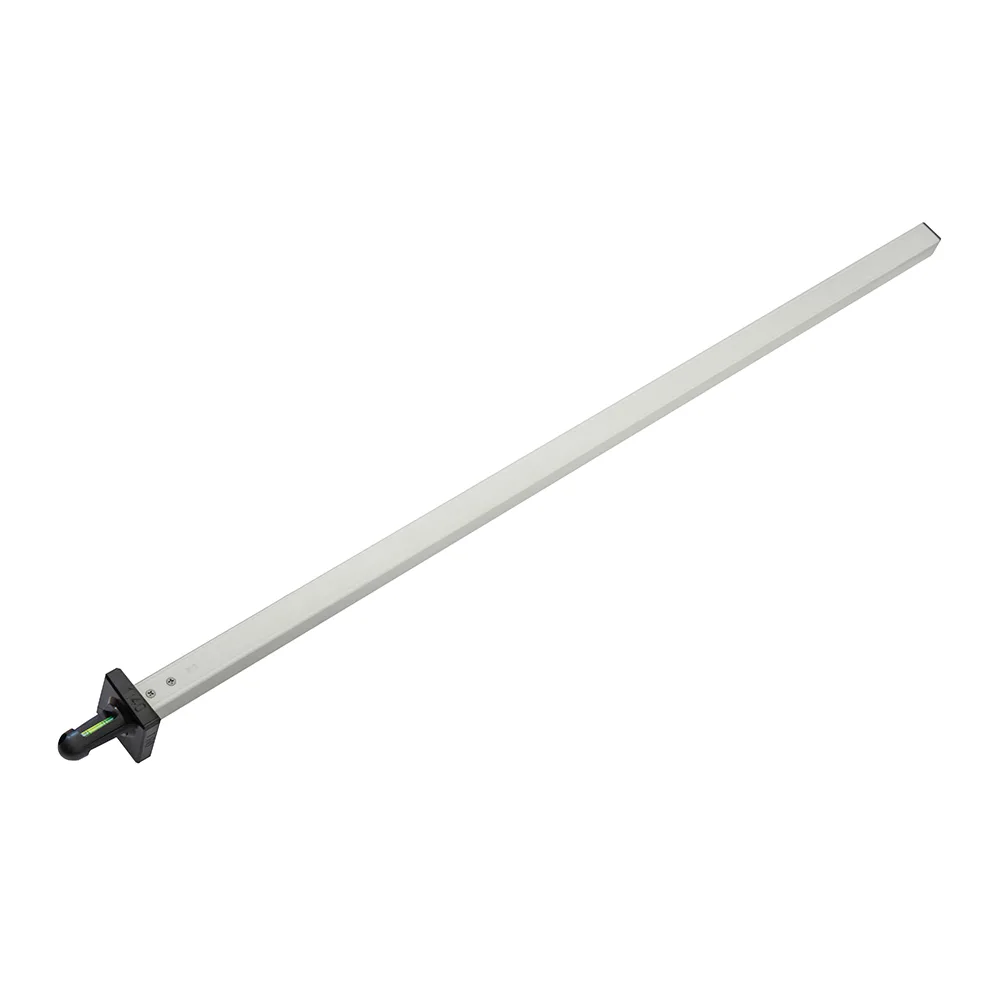

The new version of Pipefall has no moving parts, so there no longer a concern about grit and site debris getting caught in them. This means that the tool no longer needs to be set to a particular gradient, it simply needs to be placed onto the work area in the correct orientation. As these orientations are moulded into the body, this could not be easier.
PipeFall is available from Plastics Express, CPC Farnell, The Safety Supply Company and other stockists – for more information on our drainage tool retailers, click HERE!
Frequently Asked Questions
What is the correct fall for a drainage pipe?
The standard fall for above and below ground horizontal drainage pipes in the UK varies between 1 in 40 and 1 in 100. A gradient of 1 in 40 is the steepest of the commonly used falls, and 1 in 100 is the minimum recommended to maintain adequate flow velocity. Anything shallower than 1 in 100 risks solids becoming stranded in the pipe and causing a blockage.
How do you calculate the fall of a drainage pipe?
The formula is straightforward: gradient equals fall divided by distance. A 1 in 40 fall means the pipe drops 1 unit vertically for every 40 units of horizontal length. So over a 20 metre run at 1 in 40, the pipe would drop 500mm from start to finish. Getting this calculation right at the planning stage saves problems during inspection and after installation.
How do you measure pipe gradient without a laser level?
The most reliable manual method is a dedicated pipe gradient tool such as the Metex PipeFall, which has pre-set falls of 1:40, 1:60, 1:80 and 1:100 built into the body. You lay it over the pipe with the spirit level pointing downstream, select the required gradient, and adjust the pipe until the bubble reads level. It gives an accurate, verifiable reading without the cost or setup time of a laser level.
Can a spirit level be used to check pipe fall?
A standard spirit level on its own cannot measure a specific gradient, as it only tells you when something is completely level. However, a spirit level combined with a measured packing piece can be used as a DIY workaround to approximate a given fall. A purpose-made pipe gradient tool is faster and more accurate, and gives a result that is easier to demonstrate to a site inspector or Building Control.
What happens if a drainage pipe is laid without the correct fall?
A pipe laid too flat will not drain efficiently. Flow velocity drops, solids are not carried along with the water, and partial blockages build up over time. In the worst cases a completely flat or back-falling pipe will hold standing water permanently, leading to blockages, odours, and potential structural damage around the drainage run.
Do drainage pipe gradients need to be signed off by Building Control?
Yes, in most cases. Drainage work on new builds and many renovation projects requires Building Control approval, and the inspector will want to verify that pipes have been laid to the correct fall. Having a way to demonstrate the gradient on site, whether with a laser level or a manual tool like PipeFall, makes that sign-off straightforward.